Scientific Computing Visualization and Photorealistic Rendering Based on Graphics Engine
Project Overview
- Level: University Level
- Project Members: Zheng Zefeng, Gong Daxuan, Zhang Luoyun, Zhong Zhuoneng, Zhu Xinsheng
- Advisor: Lai Zhengshou
- Duration: Jan 2025 - Dec 2025
Background and Significance
Scientific computing visualization is an important bridge connecting numerical simulation with engineering applications. Current mainstream visualization software (such as ParaView), while powerful, has two major pain points: high learning curves requiring mastery of complex node editors, and limited rendering quality based on rasterization techniques that struggle to present realistic material lighting effects.
With the maturation of GPU ray tracing technology, game-level rendering quality can now be applied in scientific visualization. This project aims to develop a ray tracing-based scientific computing visualization tool to lower the barrier to visualization and enhance rendering realism, providing researchers with more intuitive and aesthetically pleasing presentation tools.
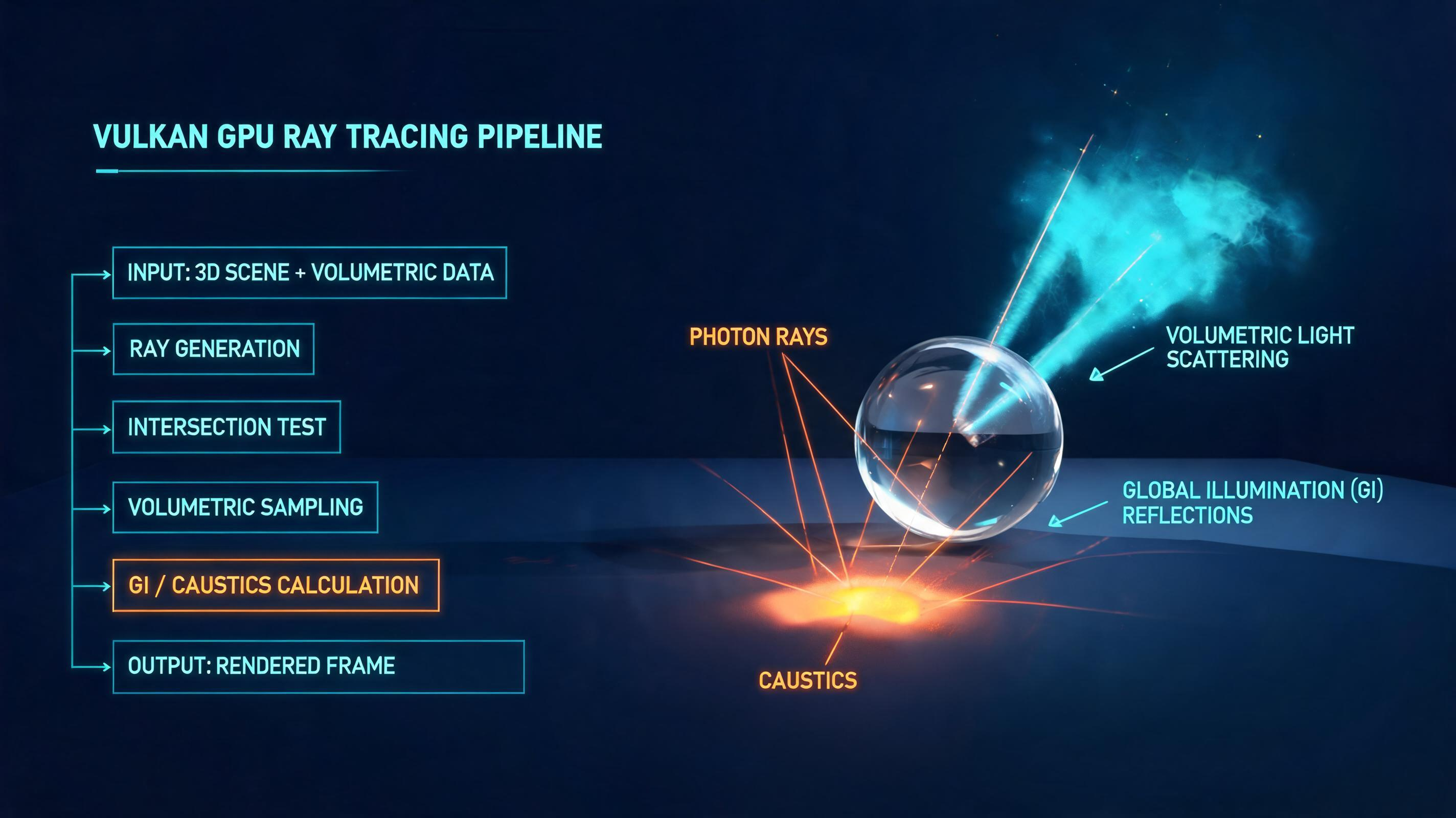
Conceptual schematic of GPU ray-traced scientific computing visualization (ClaudeBot generated)
Research Content
Ray Tracing Renderer Development
- GPU-accelerated ray tracing based on Vulkan RTX API
- Support for mesh models and volume rendering
- Material system implementation (diffuse, specular, refraction, subsurface scattering)
- Advanced effects including ambient occlusion and global illumination
AI-Assisted Rendering Workflow
- Exploring AI-generated rendering workflows
- Researching automatic translation from natural language descriptions to rendering parameters
- Lowering the barrier for non-professional users
Scientific Data Adaptation
- Support for common scientific data formats (VTK, HDF5, NetCDF)
- Visualization mapping for flow fields, stress fields, temperature fields
- Time series data animation rendering
Technical Approach
- Language: C++ / CUDA
- Graphics API: Vulkan with Ray Tracing
- AI Framework: PyTorch (for rendering workflow generation)
- Data Interface: VTK, OpenVDB
Innovation Points
- Ray tracing for scientific visualization: Introducing game-level ray tracing technology to significantly enhance rendering realism
- AI-driven workflows: Exploring LLM-assisted rendering workflow design
- GPU acceleration: Leveraging modern GPU RT Cores for real-time interactive ray tracing
Expected Outcomes
- Develop an open-source ray tracing scientific visualization software
- Support high-quality rendering of common scientific data formats
- Provide a prototype of AI-assisted rendering features
- Form reusable rendering algorithm modules
Project Outcomes
- Developed a foundational GPU ray tracing renderer
- Achieved efficient conversion from scientific data to rendering scenes
- Accumulated experience in C++ high-performance graphics software development
Project Showcase
University Innovation and Entrepreneurship Training Program Project, 2025