Multiscale Fluid-Structure Coupling and Multiphase Flow Simulation
Scientific and Technological Question: For gas-liquid-solid three-phase systems involving phase change and fragmentation, how to develop cross-scale coupling algorithms to uniformly characterize particle-fluid interactions and flow instability mechanisms?
Research Background
Fluid-structure coupling systems are ubiquitous in natural and engineering environments (erosion, sediment transport, filtration, etc.). Existing CFD-DEM methods are mainly divided into resolved and unresolved approaches, each with limitations:
- Resolved methods have high computational costs and are difficult to apply to large-scale systems
- Unresolved methods rely on empirical closure models and struggle to capture particle shape effects
- Lack of hybrid frameworks that can uniformly handle different scales (coarse and fine particles coexisting)
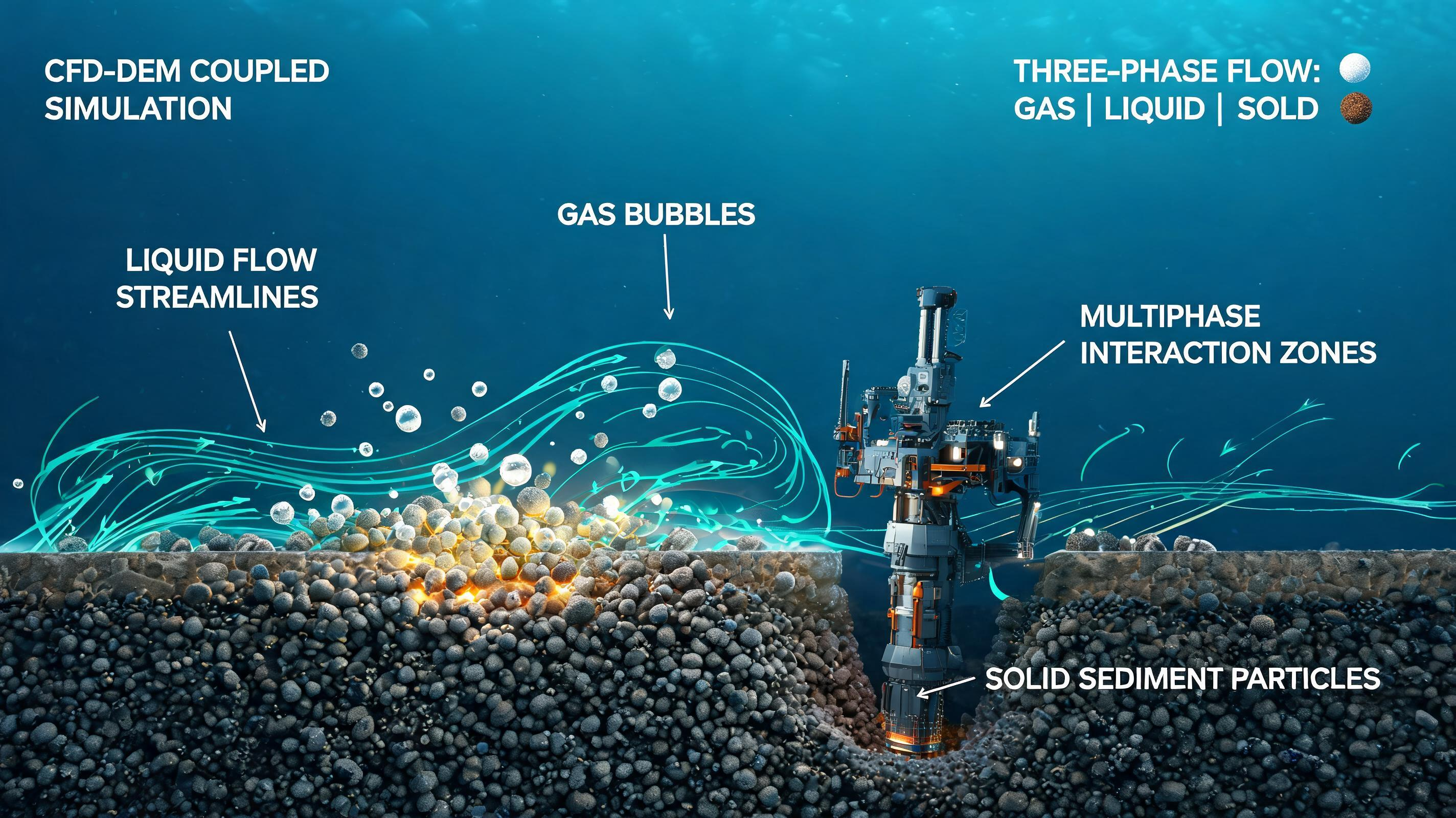
Conceptual schematic of multiscale fluid-structure coupling and multiphase flow simulation (ClaudeBot generated)
Core Research Contents
1. Hybrid Resolved-Unresolved CFD-DEM Framework
We innovatively propose an adaptive three-scale coupling strategy that automatically selects computational schemes based on the ratio of particle size to mesh size:
| Scheme | Size Ratio Condition | Application Scenario |
|---|---|---|
| Resolved | d/h > 8 | Coarse particles, fluid mesh directly resolves particle boundaries using Immersed Boundary (IB) method |
| Semi-resolved | 1/3 < d/h < 8 | Medium particles, kernel function interpolation for particle-fluid interaction |
| Unresolved | d/h < 1/3 | Fine particles, empirical drag models (Gidaspow model) |
Technical Features:
- Balances computational accuracy and efficiency for efficient simulation of wide-graded, arbitrary morphology particle systems
- SDF-based high-precision solid fraction calculation
- Conservation force feedback ensures momentum conservation
2. Phase Change-Fracture Coupling Modeling
For complex physical processes in hydrate extraction, we construct an SDF-phase field unified description framework:
- Particle Component Characterization: Phase field order parameter characterizes spatial distribution of hydrate crystals and sand components, combined with SDF for precise non-spherical particle boundary characterization
- Temperature-Pressure Driven Phase Change Dynamics: Studies hydrate phase change processes and interface migration under varying temperature-pressure conditions
- Phase Change Damage Coupling: Establishes damage relationships for cohesive strength varying with hydrate content, characterizing fragmentation evolution of sediment clasts
3. Gas Phase Multiscale Topological Evolution
For cross-scale evolution characteristics of gas phase from micro-bubbles to macro-slugs:
- Discrete-Continuous Coupled Characterization: Micro-scale bubbles use discrete description, macro bubbles use VOF method for interface capture
- Bubble Coalescence and Fragmentation Dynamics: Studies bubble collision contact and liquid film drainage processes, establishes dynamic conversion criteria between discrete bubbles and continuous interface
- Compressible Gas Phase Constitutive Model: Establishes gas phase constitutive model describing bubble temperature, pressure, and volume response
4. Multiphase Flow Instability Mechanisms
- Flow Pattern Evolution: Studies effects of temperature-pressure changes on multiphase flow structure evolution during riser transport, constructs multiphase flow pattern evolution diagrams
- Slug Flow Formation Mechanisms: Analyzes effects of hydrate decomposition rate, solid-liquid ratio, and temperature-pressure difference on slug flow formation and evolution
- Instability Quantification Criteria: Quantifies phase change-induced pressure pulsation and flow instability characteristics, establishes safety control theoretical basis
Research Funding
Guangdong Natural Science Foundation General Program (2026-): Multiphase Flow and Coupled Numerical Methods for Hydrate Solid Fluidization
Research Significance
Provides multiscale perspectives for understanding mechanical response mechanisms of granular materials under fluid action, serving:
- Marine Resource Development: Deep-sea natural gas hydrate extraction, deep-sea mining
- Infrastructure Safety: Submarine pipeline stability, breakwater design
- Chemical Process Optimization: Filtration, sedimentation, fluidized bed design
Representative Publications
Multiscale CFD-DEM Framework
-
Lai, Z., Huang, S., Kong, Y., Zhao, S., Zhao, J., & Huang, L. (2026). Hybrid resolved-unresolved CFD-DEM framework for multiscale fluid-particle systems with irregular-shaped and polydisperse particles. Journal of Computational Physics, 554, 114759. DOI | PDF
-
Lai, Z., Zhao, J., Zhao, S., & Huang, L. (2023). Signed distance field enhanced fully resolved CFD-DEM for simulation of granular flows involving multiphase fluids and irregularly shaped particles. Computer Methods in Applied Mechanics and Engineering, 414, 116195. DOI | PDF
Seepage Erosion and Multiphase Flow Applications
-
Huang, S., Wang, P., Lai, Z.#, Yin, Z.-Y., Huang, L., & Xu, C. (2026). Hybrid SDF-CFD-DEM analysis of suffusion behavior in coral sand incorporating irregular particle morphology and intraparticle voids. Engineering Geology, 364, 108616. DOI | PDF
-
Liu, Y., Yin, Z., Huang, S., Lai, Z., & Zhou, C. (2024). Resolved CFD-DEM Modeling of Suffusion in Gap-Graded Shaped Granular Soils. Journal of Geotechnical and Geoenvironmental Engineering, 150(4), 04024008. DOI | PDF