Intelligent Characterization and Data-Driven Modeling of Granular Materials
Scientific and Technological Question: How to utilize machine learning and advanced experimental techniques to achieve precise characterization of microstructures and intelligent prediction of macroscopic mechanical behavior of granular materials?
Research Background
Integrating artificial intelligence with experimental geomechanics, we are advancing granular material research from empirical description to data-driven quantitative prediction. This direction focuses on intelligent characterization, virtual generation, and mechanical performance prediction of particle morphology, providing high-quality data support and efficient analysis tools for computational geomechanics.
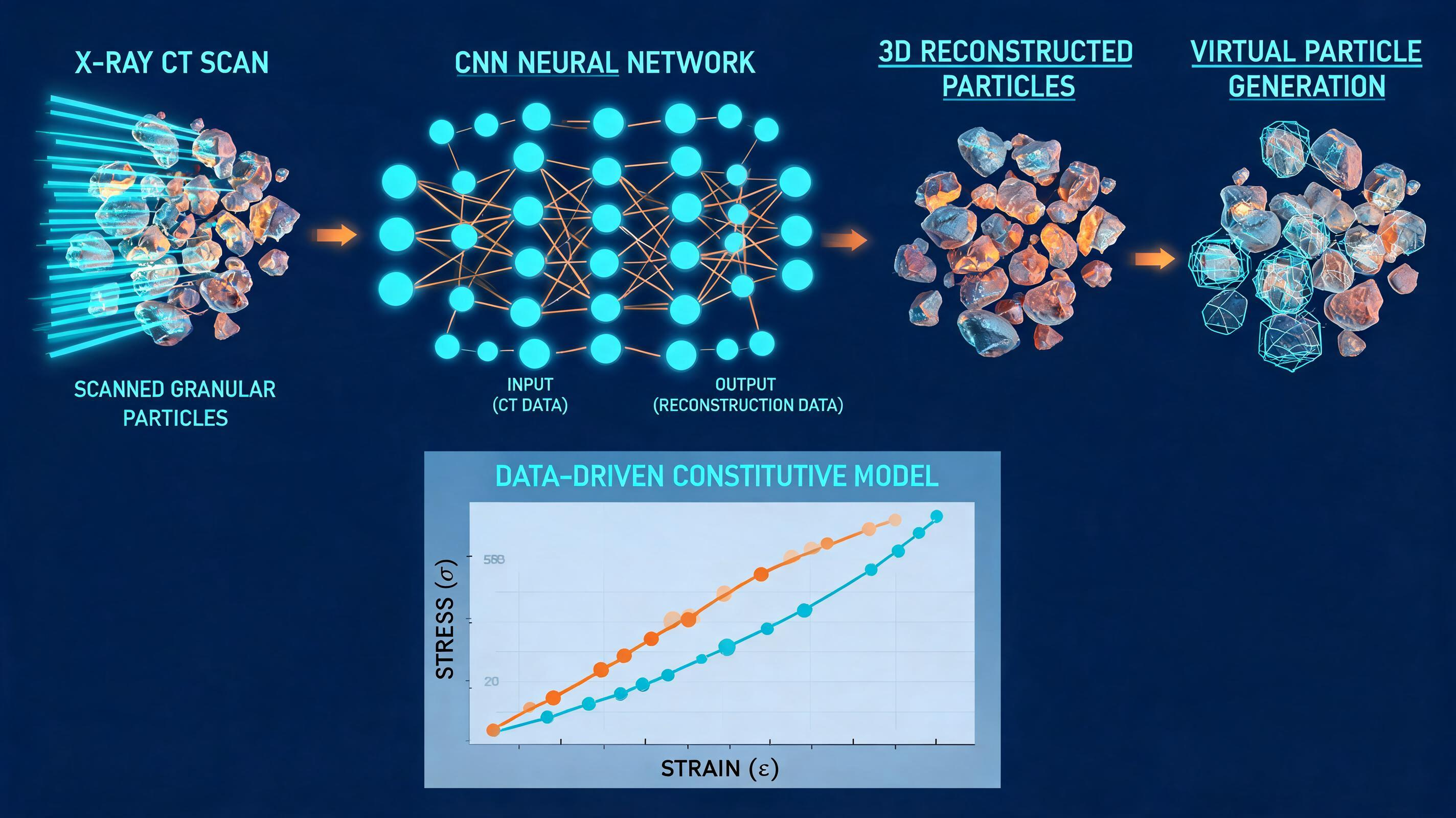
Conceptual schematic of intelligent characterization and data-driven modeling of granular materials (ClaudeBot generated)
Core Research Contents
1. Deep Learning Image Reconstruction and Morphology Analysis
Technical Breakthroughs:
- CNN-based 3D Image Segmentation: Extracting particle morphology and pore structure from X-ray CT scans using convolutional neural networks and 3D image segmentation algorithms
- Sub-voxel Level Analysis: Develop "machine learning image enhancement → level set segmentation" collaborative morphology reconstruction methodology, conquering sub-voxel level particle morphology analysis challenges
- Extreme Environment Particle Characterization: Successfully applied to special granular material morphology digitalization including Martian regolith simulant and deep-sea coral sand
Application Outcomes: Established a full-process digital technology system for particle "morphology acquisition — morphology reconstruction — virtual generation".
2. Intelligent Virtual Particle Generation
Technical Methods:
- Spherical Harmonic Coefficient-Random Field Method: Establishing particle virtual generation methods combining spherical harmonic coefficients with random fields, revealing particle morphology spectrum evolution patterns
- Diffusion Model-Driven Approach: Developing virtual porous granular material generation frameworks based on diffusion models, achieving intelligent generation of high-fidelity particle morphologies
- Morphology Similarity: Generated virtual particles exhibit high morphology similarity with measured samples, breaking through limitations of physical experimental sample quantities
3. Data-Driven Constitutive Modeling
Research Contents:
- Morphology-Performance Correlation: Constructing machine learning mapping models between particle shape descriptors and macroscopic mechanical performance
- Neural Network Contact Mechanics: Developing neural network-driven shape characterization and computational particle mechanics methods, achieving efficient contact detection and mechanical calculation based on SDF
- Surrogate Model Acceleration: Establishing surrogate models for macroscopic responses of granular materials, enabling rapid parameter inversion and optimization design
4. Special Soils Research (e.g., Calcareous Sand)
Research Objects:
- Coral Sand: Establishing multiscale computational processes considering microscopic morphology effects for coral sand particles with intra-particle voids
- Bio-cementation: Studying particle cementation mechanisms during Microbially Induced Calcite Precipitation (MICP) processes
- Martian Regolith: Conducting DEM modeling of Martian regolith simulant particles, serving deep space exploration engineering
Key Findings:
- Intra-particle void structures of coral sand significantly affect its compression and crushing behavior
- Particle morphology irregularity is the key factor controlling mechanical response of calcareous sand
Research Significance
Expanding applications of machine learning in computational mechanics, advancing granular material research from "empirical trial-and-error" toward quantitative data-driven prediction.
Representative Publications
Deep Learning and Intelligent Computing
-
Li, C., Lai, Z.#, Huang, S., & Huang, L. (2026). Neural network-driven shape representation and computational particle mechanics via signed distance fields. Engineering Applications of Artificial Intelligence, 167, 113913. DOI | PDF
-
Huang, S., Wang, P., Lai, Z.#, Yin, Z., Huang, L., & Xu, C. (2024). Machine-learning-enabled discrete element method: The extension to three dimensions and computational issues. Computer Methods in Applied Mechanics and Engineering, 432, 117445. DOI | PDF
-
Lai, Z., Chen, Q., & Huang, L. (2021). Machine-learning-enabled discrete element method: Contact detection and resolution of irregular-shaped particles. International Journal for Numerical and Analytical Methods in Geomechanics, 46(1), 113-140. DOI | PDF
Virtual Particle Generation and Diffusion Models
- Li, C., Huang, L., Lai, Z.#, Huang, S., & Lin, Y. (2026). A diffusion-based generative framework for virtual porous granular media generation. Powder Technology, 473, 122230. DOI | PDF
Particle Morphology Characterization and CT Image Reconstruction
-
Huang, S., Huang, L., Lai, Z.#, & Zhao, J. (2023). Morphology characterization and discrete element modeling of coral sand with intraparticle voids. Engineering Geology, 315, 107023. DOI | PDF
-
Lai, Z., Chen, Q., & Huang, L. (2019). Reconstructing granular particles from X-ray computed tomography using the TWS machine learning tool and the level set method. Acta Geotechnica, 14(1), 1-18. DOI | PDF
-
Lai, Z. & Huang, L. (2021). A polybezier-based particle model for the DEM modeling of granular media. Computers and Geotechnics, 134, 104052. DOI | PDF